What Khala is
Khala is an agentic builder for corporate IT teams. A team writes down what an agent must do, attaches measurable KPIs and business tests, and Khala builds the agent, verifies it against those tests, deploys it and watches it in production.
The company decides, from one panel, which technology agents may use: which models, which tools, which policies. A team cannot pick something the company has not approved.
The lifecycle
Section titled “The lifecycle”| Stage | What happens | Who acts |
|---|---|---|
| Define | The team writes the spec: purpose, process, rules, limits, tools, KPIs and tests | Builder role |
| Build | Khala produces the agent from a published spec version, on the approved stack | Khala |
| Verify | Tests run against the build; KPIs are measured against their targets | Khala |
| Deploy | The build goes to staging, then to production through a gate and approvals | Builder and approvers |
| Observe | Runs, cost, latency and alerts; an emergency stop on three levels | Everyone, by role |
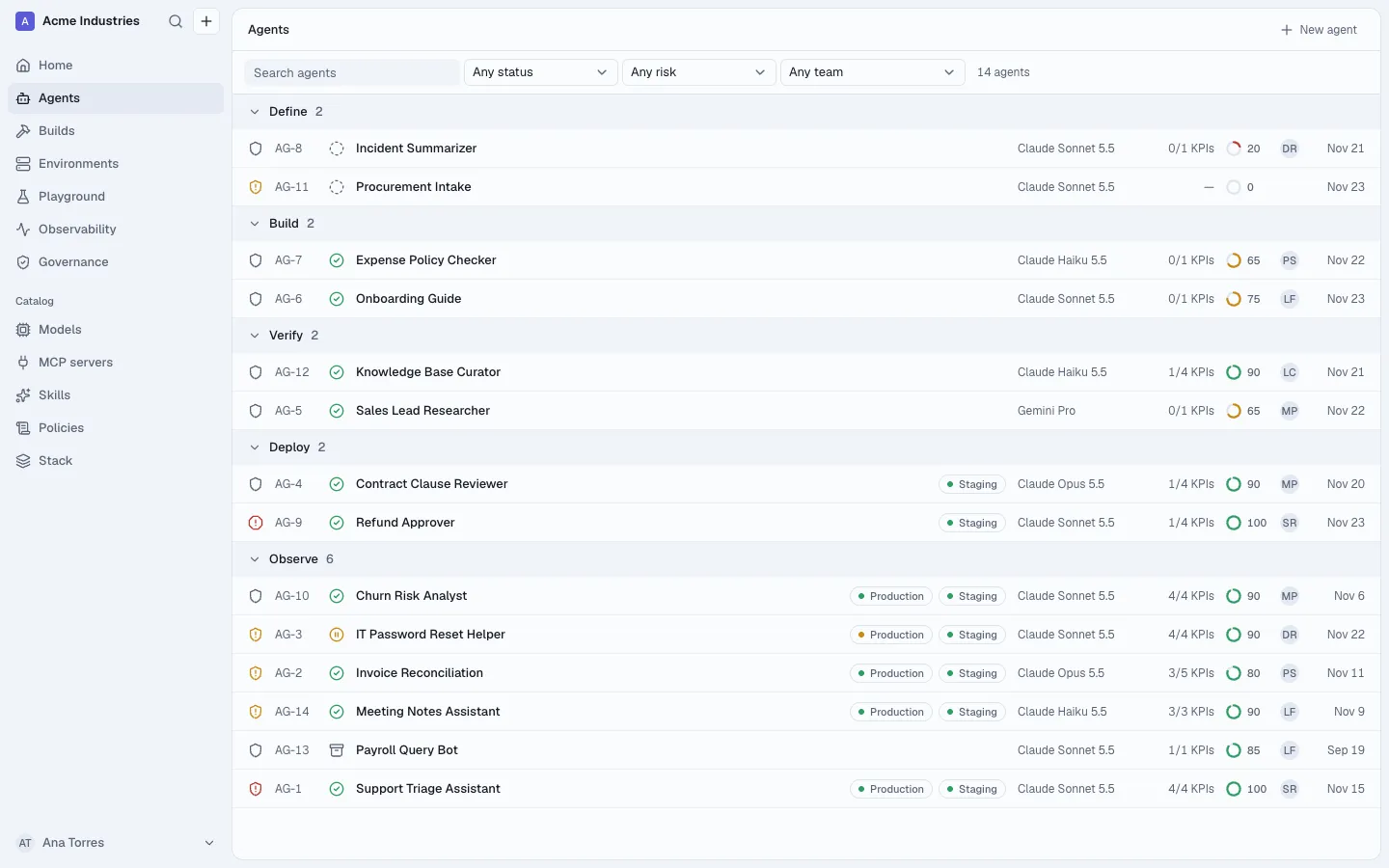
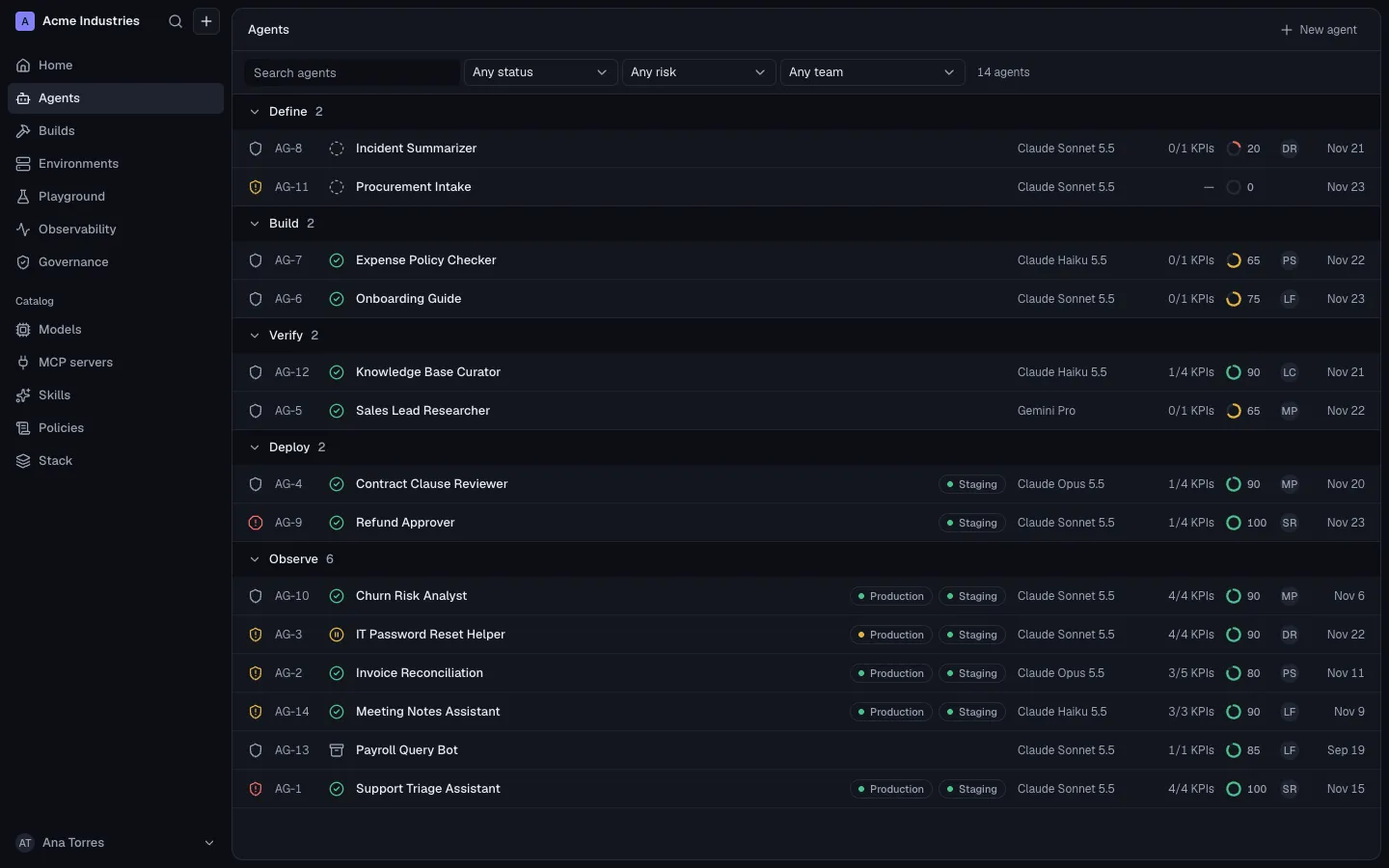
The agent list in the panel is grouped by these stages, so anyone can see where each agent is.
What makes it different
Section titled “What makes it different”The spec is the contract. An agent is not a prompt someone tuned by hand. Its definition is a versioned document with a process, rules of the form “when this, do that”, and limits: what the agent never does, what needs approval, what goes to a person. Published versions cannot be edited. Tests point at the rules and limits they check, so coverage is visible.
The code is yours. Every build ends as a pull request in your repository, on the stack your company approved. Khala does not hold the agent: the code stays with you and keeps working if you stop using Khala. See Ownership and exit.
Technology is standardised by construction. Each technical choice of an agent is either “recommended” or an option the company approved in the catalog. Unapproved options cannot be selected.
Promotion to production is a gate, not a button. What a build must score, which findings block it and who must approve depend on the agent’s risk level, through versioned risk policy templates.
The layer around the model is the product. The model that writes code is replaceable. What makes its output dependable is the harness: isolation, context, budgets, gates and evidence. See What a harness is.
The panel
Section titled “The panel”Home, Agents, Builds, Environments, Playground, Observability, Governance, Catalog (models, MCP
servers, skills, policies, stack) and Settings. It ships as a web application and as a desktop
application, in English and Spanish, with light and dark themes and
a command palette on ⌘K / Ctrl K.