Build and verify
A build is what Khala produces from one published spec version. It runs six steps, shown as a timeline with live logs:
- Plan. Read the spec and resolve the stack against the catalog.
- Generate. Write the agent’s code.
- Wire tools. Connect the MCP servers and skills of the spec. A build fails here if the spec uses a blocked or draft server.
- Prepare tests.
- Run evals.
- Package.
Every build keeps its steps, its logs and its resolved stack: one entry per category, saying whether the choice came from the team or from the recommended default. Builds are never overwritten; history is append-only.
How the code gets written and checked is described in How the builder works.
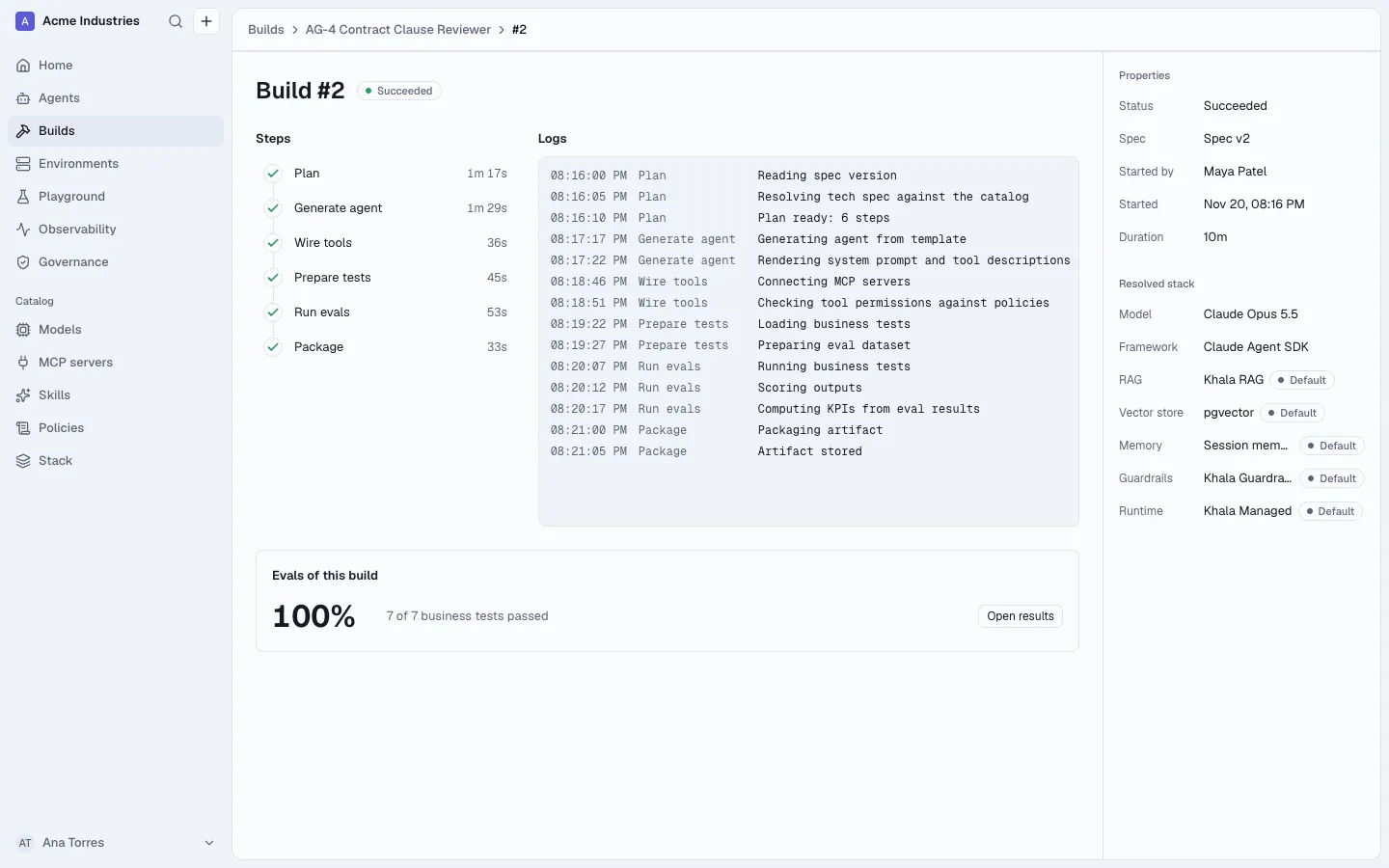
An eval run executes the agent’s tests against a build. It records, per test, the input, the expected result, the actual result, whether it passed and why. It compares each result with the previous build and marks it as the same, regressed, fixed or new. Regressions are highlighted.
KPIs whose source is evals are measured in the same run and shown against their targets.
Evaluation
Section titled “Evaluation”Each build gets a score in four dimensions.
| Dimension | What it measures |
|---|---|
| Business | The share of business tests that passed |
| Security | The share of security tests that passed |
| Robustness | The share of robustness tests that passed |
| Construction | Whether the build follows your standards and architecture |
Findings take points off the weighted score: a failed critical test, a failed security or robustness test, a rule or limit that no test covers. Each finding has a severity: critical, high, medium or low.
The weight and the minimum of each dimension, the penalty per finding and whether a critical finding blocks promotion are set by the risk policy template of the agent’s risk level.