Agents, specs and tests
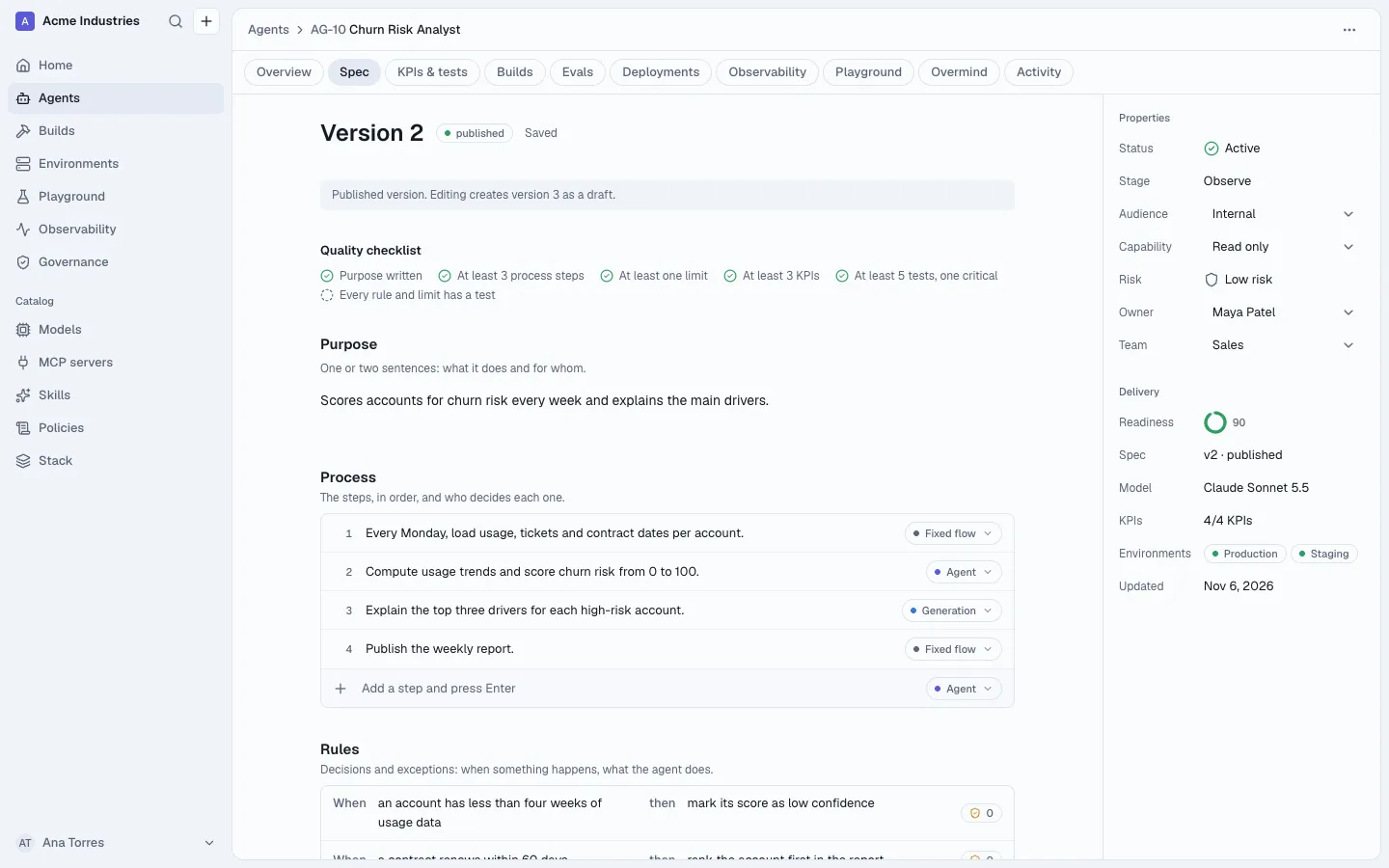
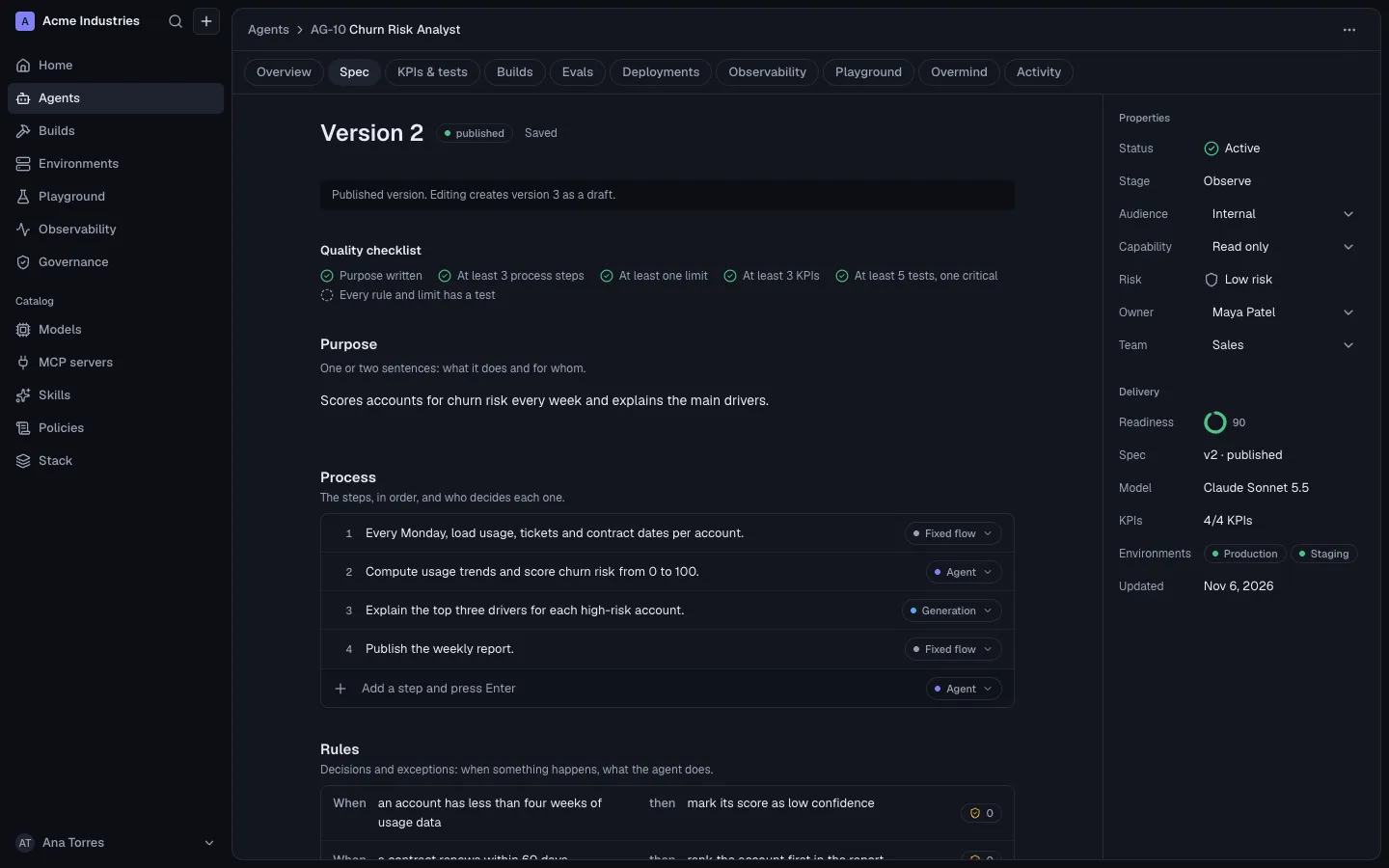
The agent is the unit of work. It has a short key (AG-12), an owner, a team, a lifecycle stage,
a status, a risk level and a readiness score.
The spec
Section titled “The spec”The spec is the written definition of the agent. It is a structured document, not free text:
| Section | Content |
|---|---|
| Purpose | What the agent is for, in a sentence or two |
| Inputs and outputs | What it receives and what it returns |
| Knowledge | What it needs to know to do the work |
| Process | Ordered steps. Each step is a fixed flow, an agent step, a decision or a generation |
| Rules | Condition → action |
| Limits | What the agent never does, what needs approval, what it hands over to a person |
| Tools | MCP servers and skills from the catalog |
| Policies | The policies that apply to it |
| Tech spec | One choice per category: model, framework, RAG, vector store, memory, guardrails, runtime |
An agent has at most one draft. Publishing freezes a version, and published versions cannot be changed: a build always refers to an exact version. Steps, rules and limits keep their identity across versions, so a test keeps pointing at the rule it checks after the spec is edited.
Risk level
Section titled “Risk level”Risk is derived, not chosen. It comes from who the agent serves and what it can do.
| Audience | Capability | Risk |
|---|---|---|
| Internal | Read | Low |
| Internal | Write | Medium |
| Customer | Read | High |
| Customer | Write | Critical |
The risk level selects the risk policy template that governs promotion to production. See Deploy and operate.
A KPI is a measurable target: a metric, a comparator, a value, a window and a source (evals or production). Metrics come from a library (success rate, p95 latency, cost per run, escalation rate) or are defined by the team.
Business tests
Section titled “Business tests”A test has an input, an expected output or criteria, a comparison method and a priority (critical or normal). Each test belongs to a dimension: business, security or robustness. Tests are written by hand, imported from CSV or JSON with a preview and per-row errors, generated from the rules and limits of the spec, or saved from a try in the playground.
A test can declare which rule or limit it covers. The spec shows coverage next to each rule and limit, and a rule with no test is reported as a finding.
A share of each agent’s tests is held out: marked as hidden from the builder. The share is set by the risk policy. The reason is on the harness page: a builder that can see every test can pass them without being right.
Readiness
Section titled “Readiness”Readiness is a score from 0 to 100, always shown with what is missing.
| Check | Points |
|---|---|
| Has an owner | 10 |
| Has a purpose | 10 |
| At least 3 process steps | 10 |
| At least 1 limit | 10 |
| At least 3 KPIs | 15 |
| At least 5 tests, one of them critical | 15 |
| Every rule and limit is checked by a test | 10 |
| A published version exists | 10 |
| Latest eval at 90% or more with no critical failure | 10 |