Catalog
The catalog is what the organization approves. Changing it requires the admin role, and every change is recorded in the audit log.
Models
Section titled “Models”Each model has a provider, a status (approved, restricted or blocked), a price per million tokens, a context window and regions. At most one model is the recommended one. Restricted models need an approval before an agent can use them; blocked models cannot be selected.
MCP servers
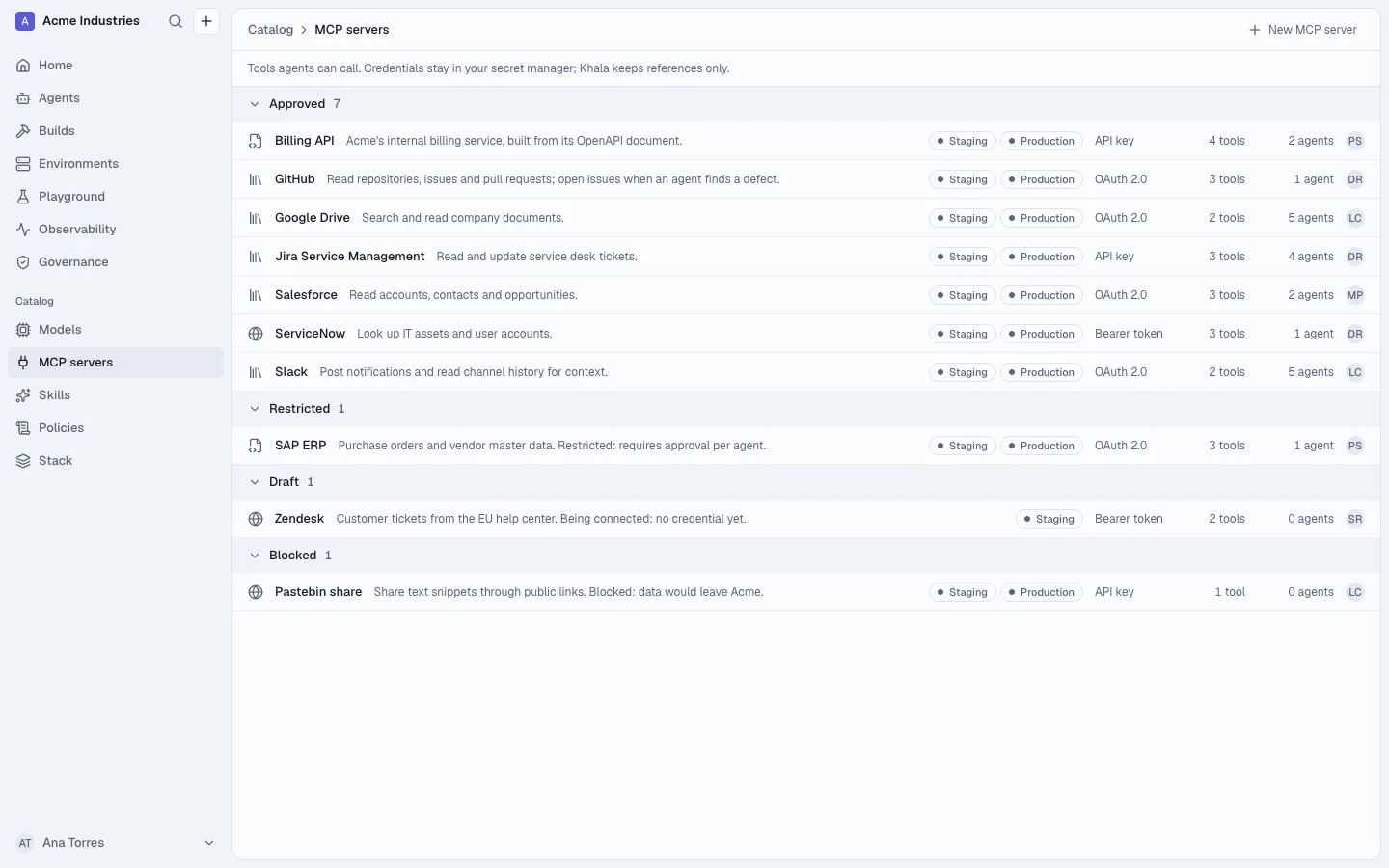
Section titled “MCP servers”An MCP server gives an agent tools. There are four ways to add one: pick it from the catalog, connect an existing server by URL, build one from an OpenAPI document, or hand Khala your own server to build, verify and run. See Hosted MCP servers and tool gateway.
For each server Khala records:
- Identity: name, purpose (what it is for and when an agent should use it), owner and team.
- Base URL per environment.
- Authentication: none, API key, bearer or OAuth2. Khala stores the non-secret settings (header name, token URL, scopes) and a reference to the credential in your secret manager, one per environment. The secret itself is never stored. See Secrets and model providers.
- Tools: which operations are exposed, with the name and description the model will read, a risk level (read, write or destructive) and whether the tool needs human approval.
- Limits: requests per minute and timeout.
- Data classification of what the server exposes: public, internal, confidential or restricted.
- Access: which environments may use it and which teams.
Skills
Section titled “Skills”A skill is a set of instructions in Markdown with supporting files, a description of when to use it, a version and a status. Skills come from our catalog or are written by your teams.
Policies
Section titled “Policies”| Type | What it sets |
|---|---|
| Cost | Maximum per run, monthly budget, action on breach: warn, throttle or pause |
| Data | Handling of personal data (allow, redact or block), residency, trace retention, blocked data classifications |
| Actions | Allowed tools, human approval for writes |
| Models | The list of allowed models |
| Promotion | The gates a deployment must pass |
A policy runs in enforce or monitor mode, for the whole organization or for specific agents.
Policies are versioned. Cost, data, action and model policies are applied while an agent runs, on
every tool call it makes; see Hosted MCP servers and tool gateway.
The production gate comes from the risk policy templates described in
Deploy and operate.
Frameworks, RAG, vector store, memory, guardrails and runtime. Each category has approved options and one recommended option. A spec either takes the recommendation or picks an approved option, and a build records which choices were the team’s and which were defaults.