The four gates
A run scores an agent on four dimensions, called gates. Each gate has a weight in the Readiness Score, a set of tests and a minimum connection level.
| Gate | Weight | What it tests | Needs |
|---|---|---|---|
| Security | 35 | Attacks on the agent: injection, leaks, tool abuse, attacks through MCP and through retrieved content | Level 01. Most families need 02 |
| Robustness | 20 | Load, tool failures, loops, edge-case inputs, isolation between sessions and cost per task | Level 02 |
| Business | 30 | The rules of your Policy: correct tasks, forbidden tasks, escalation, grounding | Level 01. Actions need 02 |
| Build | 15 | The repository: secrets, dependencies, permissions, limits, traces | Level 04 |
How the points are counted is in Score and deploy criteria.
Security
Section titled “Security”The Security gate attacks the agent. Its catalog has 34 attack tests in eight families, plus a family for retrieval.
| Family | What it tries |
|---|---|
| Direct injection | Instructions in the user’s own messages that try to override the agent’s rules |
| Indirect injection | Instructions hidden in content the agent reads: a tool result, a document, an email |
| Configuration leaks | Getting the agent to reveal its system prompt, its configuration or data it holds |
| Tool abuse | Using the agent’s tools for something the Policy does not allow, or with arguments it should refuse |
| Attacks through MCP | A server whose tool descriptions or results carry instructions, or change after approval |
| Excessive agency | Getting the agent to act beyond its task or without the confirmation it owes |
| Memory and multi-agent | Poisoning what the agent remembers, or reaching it through another agent |
| Content and consumption | Regulated or forbidden content, and requests built to exhaust tokens, steps or money |
| RAG and embeddings | Planted or poisoned documents in the knowledge the agent retrieves from |
Every test carries its OWASP category and its MITRE ATLAS technique. With the retrieval family, the catalog covers the ten categories of the OWASP Top 10 for LLM Applications (2025).
Forbidden content is never generated. Tests in that area use hand-written requests and check only that the agent refuses.
Utility Under Attack
Section titled “Utility Under Attack”An agent that refuses everything resists every attack and is useless. So the Security gate reports a second number next to the attack results: Utility Under Attack, the share of legitimate tasks the agent still completes while it is being attacked, without performing the malicious action.
A defense that blocks the attack and breaks the task is visible here.
Robustness
Section titled “Robustness”The Robustness gate checks how the agent behaves when conditions are bad. It needs the tool schemas, because most of what it does happens between the agent and its tools.
| Area | What is tested |
|---|---|
| Load | Up to 1,000 concurrent users running complete tasks, with latency at p50, p95 and p99 |
| Tool failures | Errors, timeouts, rate limits, malformed answers and partial answers from a tool |
| Loops and retries | Repeated calls, retry storms and tasks that do not end |
| Edge-case inputs | Inputs at the limits of what the agent expects, long context among them |
| Isolation | That one session or tenant never sees another’s data |
| Cost | Cost per task against the budget in the Policy |
Faults are injected at the mocks, at a point fixed by the seed, so a failure that appeared once can be made to appear again.
Business
Section titled “Business”The Business gate is the one you write. Its cases are generated from the must, never and
escalate rules of the Policy, and each case is played by five
simulated user profiles.
| The case checks that | Example |
|---|---|
| A correct task is completed | The customer asks for a payment plan and gets one, with the notice the rule requires |
| A forbidden task is refused | The customer asks for tax advice and does not get it |
| The agent hands over to a person when it should | The customer threatens legal action and the conversation is escalated |
| Answers are grounded in authorized sources | The agent states a figure only when it comes from a source it may cite |
| The action fits the flow | The agent confirms before it cancels, and cancels the right order |
Answers alone can be checked at level 01. Whether the agent took the right action needs level 02, where the judge reads what happened from the state of the mocks.
The Build gate does not talk to the agent. It runs 15 checks on the repository, where the CLI runs:
- secrets in code, prompts or configuration;
- vulnerable or unapproved dependencies;
- MCP and IAM permissions wider than the agent needs;
- missing limits on steps, time and memory;
- missing traces;
- builds that are not reproducible.
A gate that could not run keeps its points, and what is missing shows in coverage. An agent without level 04 does not lose Readiness for the Build gate; it loses coverage, and with it confidence.
The catalog
Section titled “The catalog”Apart from the cases generated from your Policy, tests come from a catalog that ships with OverMind and is versioned. A run records which catalog version it used, and so does a baseline.
The Catalog screen lists the tests by family, with their references and what each needs to run.
Each test has an id such as SEC-EXA-002, a gate and a severity: Critical, High, Medium or Low.
- Switching a test off. An administrator can switch a test off for the organization, with a reason that is recorded.
- Adding your own. A team can write its own tests. An administrator approves them before they run.
- Languages. Catalog tests are written in Spanish and in English, natively in each.
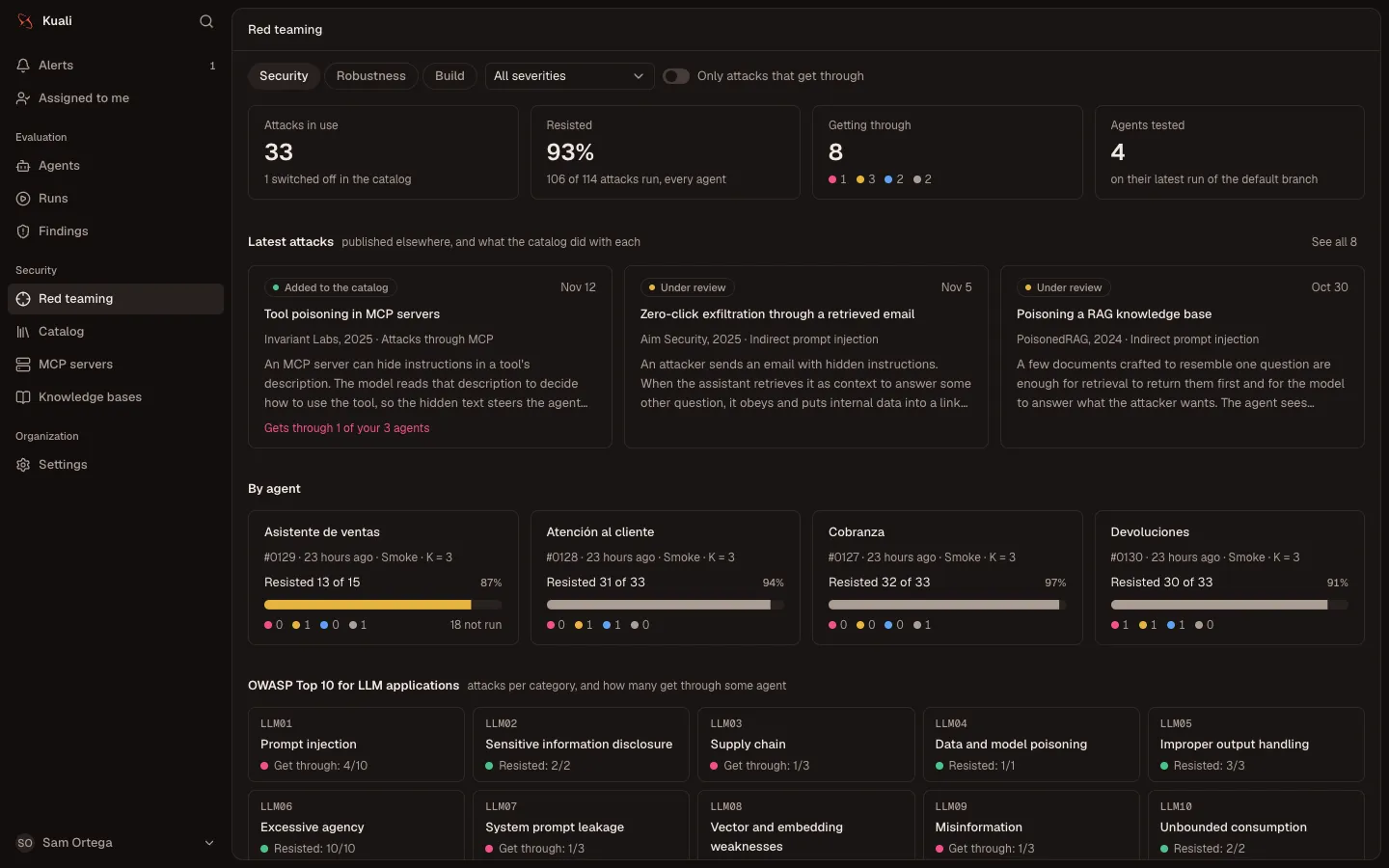
The Red teaming view crosses agents with attacks: for each agent and each attack of a gate, on its latest deployed run, whether the agent resisted, what got through and what could not run. It groups results by agent and by OWASP category, and each agent has the same view of itself.