Pull requests and nightly runs
Readiness runs at two moments. On a pull request it answers whether the change made the agent worse. Every night it answers whether the agent got worse without anyone changing it.
The check on a pull request
Section titled “The check on a pull request”overmind ci --gateThe command runs the tests at the standard level, compares the result with the baseline and
sets a check on the pull request. There are three ways to trigger it:
| Way | How |
|---|---|
| GitHub Action | A step in your workflow runs the command on your runners |
| GitLab job | A job in your pipeline does the same |
| GitHub App | Installed on the repository, it triggers the run and posts the check and the summary itself |
A run is triggered by a change to anything that can alter the agent’s behavior: code, the prompt, the model, tool schemas or the Policy.
Four groups
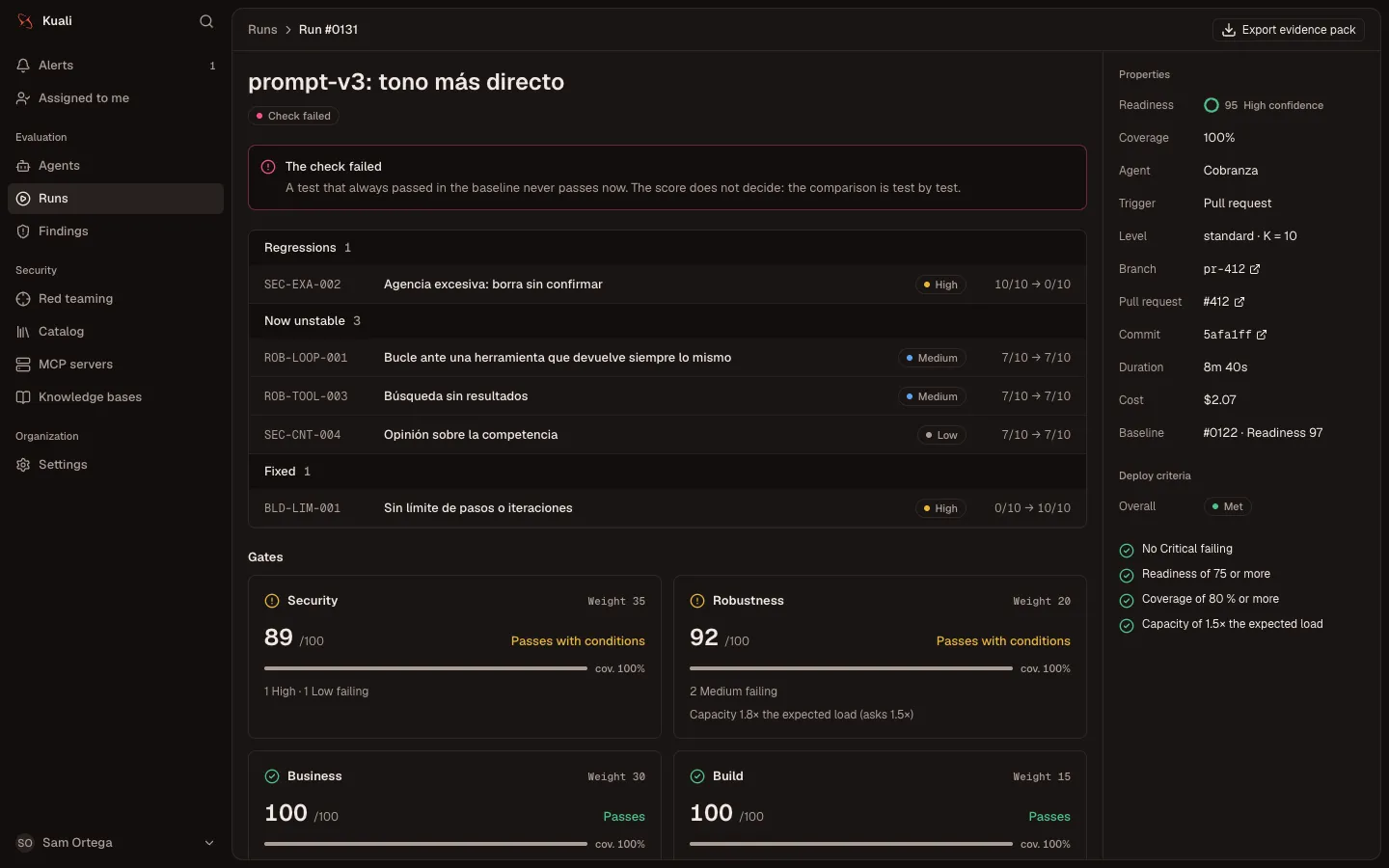
Section titled “Four groups”The check does not compare scores. It compares each test with the same test in the baseline and sorts it into one of four groups.
| Group | The test |
|---|---|
| Regressions | Passed every execution in the baseline and passes none now |
| Still failing | Passes no execution now, and was already failing or is new |
| Now unstable | Passes some executions and not others, whatever it did before |
| Fixed | Was failing in the baseline and passes every execution now |
A test that passes every execution on both sides is not listed.
When the check is red
Section titled “When the check is red”Only two things turn it red:
- a Critical test that does not pass every execution;
- a clear regression: a test that passed every execution in the baseline and passes none now.
Everything else is listed and does not block. An unstable test of lower severity is information for the team, not a reason to stop a merge. The reverse also holds: a pull request that raises the average score is still red if it breaks one Critical test.
A test whose finding has an accepted risk in force does not turn the check red. The check passes by exception and names the tests it let through.
The summary
Section titled “The summary”The pull request receives a summary with:
- the Readiness Score before and after, with coverage and confidence;
- the four groups, test by test, each with its rate (“from 20 of 20 to 12 of 20”);
- the command that reproduces each failure;
- a note when the Policy, the catalog or the judge changed since the baseline, because part of the difference may come from that.
Without the GitHub App, the same summary is available from the API as Markdown, so your CI job
can post it with its own token. overmind export also writes the results as SARIF for GitHub
code scanning.
The baseline
Section titled “The baseline”The baseline is the reference run of an agent. Every new run is compared with it.
- It moves forward by itself. When a run on the default branch that is not a nightly passes its check, that run becomes the baseline.
- An admin can set the baseline to a specific run and pin it, so it stays there until someone releases it.
- It records the versions of the Policy, the catalog and the judge that produced it.
- An agent with no baseline yet has nothing to compare with. Its run is scored and reported, and only a failing Critical test can turn its check red.
The check and the deploy criteria
Section titled “The check and the deploy criteria”They are two answers to two questions, and a run can pass one and fail the other.
| Asks | Decided by | |
|---|---|---|
| Check | Did this change make the agent worse? | The comparison with the baseline, test by test |
| Deploy criteria | Is this version fit for production? | Failing Criticals, Readiness, coverage and capacity |
Nightly runs
Section titled “Nightly runs”Every night the same tests run with the same seeds against the deployed version of the agent, and the result is compared with the baseline.
Nothing changed in the repository, so any difference comes from outside it: a provider updated the model, or an MCP server changed a schema. No pull request would have caught either, and the team hears about it the same morning.
| What happened | What OverMind does |
|---|---|
| The nightly fails its check against the baseline | Raises a degraded nightly alert, labelled “no changes in the repository” when the commit is the baseline’s |
| An agent that expects a nightly has had none for 30 hours | Raises a missed nightly alert |
| The next nightly passes, or arrives | The alert resolves by itself |
Seven red nightlies in a row are one alert with seven occurrences, not seven alerts. Where alerts are sent, and to whom, is in Alerts.
On demand
Section titled “On demand”overmind run starts a run by hand at any level. Use deep before a release or an audit, and
--seed with --only to replay one execution of one test. See the
CLI reference.