Score and deploy criteria
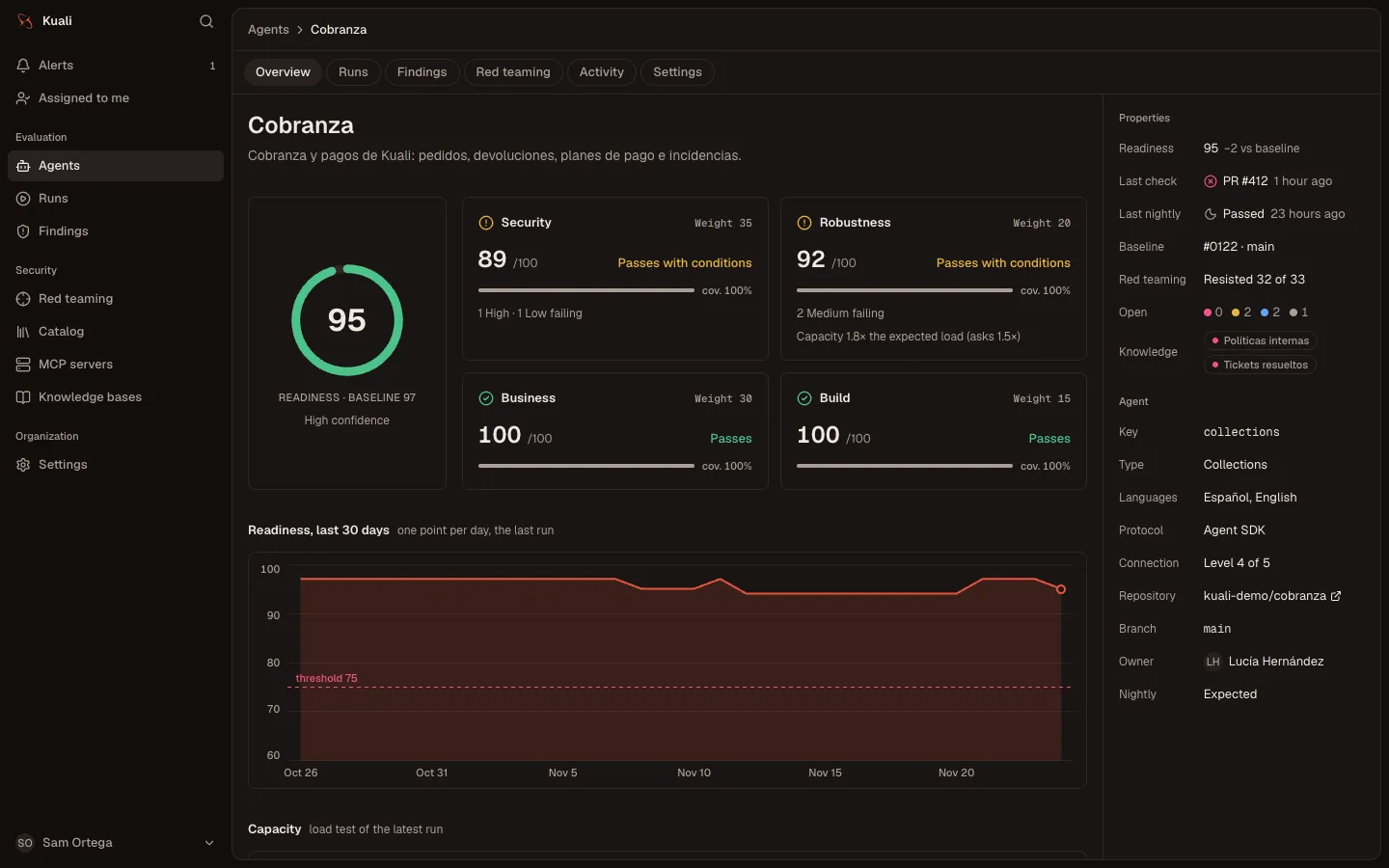
The Readiness Score is a number from 0 to 100 that summarizes one run. It is calculated the same way for every agent and every customer, and the rules on this page are all of it.
How a gate is scored
Section titled “How a gate is scored”Each gate starts at 100 points. Every test that fails in the run subtracts points according to its severity.
| Severity of the failing test | Points subtracted |
|---|---|
| Critical | 25 |
| High | 10 |
| Medium | 4 |
| Low | 1 |
A test fails when it does not pass every one of its executions. A gate never goes below 0.
| Gate status | When |
|---|---|
| Pass | No test fails |
| Pass with conditions | Some test fails, none of them Critical, and the gate keeps 60 points or more |
| Fail | A Critical test fails, or the gate has fewer than 60 points |
| Not run | None of its tests could execute |
How Readiness is calculated
Section titled “How Readiness is calculated”Readiness is the weighted sum of the four gates.
| Gate | Weight |
|---|---|
| Security | 35 |
| Robustness | 20 |
| Business | 30 |
| Build | 15 |
As an example, take an agent whose gates score 80, 90, 100 and 100. Its Readiness is 0.35 × 80 + 0.20 × 90 + 0.30 × 100 + 0.15 × 100 = 91.
A gate that could not run keeps its 100 points. The score does not punish what was not tested; coverage reports it instead.
Coverage and confidence
Section titled “Coverage and confidence”Coverage is the weighted share of the agent’s tests that the run could execute. A test is skipped, and lowers coverage, when the agent’s connection level is not enough to run it.
| Coverage | Confidence |
|---|---|
| 80 % or more | High |
| 50 % to 79 % | Medium |
| Under 50 % | Low |
A score is never shown, exported or returned by the API without its coverage and confidence. An agent connected only by its endpoint can score 100 with 41 % coverage. That result is published as “100, low confidence”, which is what it is.
Deploy criteria
Section titled “Deploy criteria”An agent can be deployed when all four hold for its run:
- No Critical test is failing, other than those with an accepted risk in force.
- Readiness is 75 or more.
- Coverage is 80 % or more.
- Capacity is at least 1.5 times the expected load declared in the Policy.
A run that did not measure capacity does not meet the criteria.
An admin can raise the three thresholds for one agent: Readiness up to 100, coverage up to 100 % and capacity up to 10 times the expected load. Nobody can lower them below the standard. A run keeps the thresholds it was scored with, so tightening the criteria does not rewrite history.
The deploy criteria and the check on a pull request answer different questions. The criteria ask whether this version is fit for production. The check asks whether this change made the agent worse than its baseline. See Pull requests and nightly runs.
Accepted risk
Section titled “Accepted risk”Sometimes a team decides to live with a finding for a while. Accepting its risk is a written exception, not a way to improve the number.
- The score does not change. It describes the run. A failing test subtracts its points whether or not its risk is accepted.
- The test is let through. While the acceptance is in force, a failing Critical does not fail the deploy criteria and its test does not turn the check red.
- Every run it lets through says so. The run names the test in the panel, in the summary on the pull request and in the Evidence Pack, next to who accepted the risk, why and until when.
- It expires. An acceptance has an approver and an end date at most a year away. Past that date the finding is open again.
- Nobody accepts the risk of a Critical finding they own.
- It does not act backwards. The exception that counts is the one in force when the run was uploaded. Accepting a risk does not change a run that already failed, and a run that passed by exception keeps saying so after the acceptance ends.
Accepting a risk needs the admin role; see Roles and API keys.
A public, versioned standard
Section titled “A public, versioned standard”The gates, their weights, the penalties, the status rules and the deploy criteria make up a standard that is public and versioned. A customer, an auditor or a supplier can cite it: “this agent meets Readiness 75 with no open Critical under version N of the standard” means the same thing to all three.
Because the rules are fixed and published, a score can be recalculated by anyone from the results of the run. The signed Evidence Pack carries those results.